Diamond fluorescence: advantage, flaw or simply a characteristic
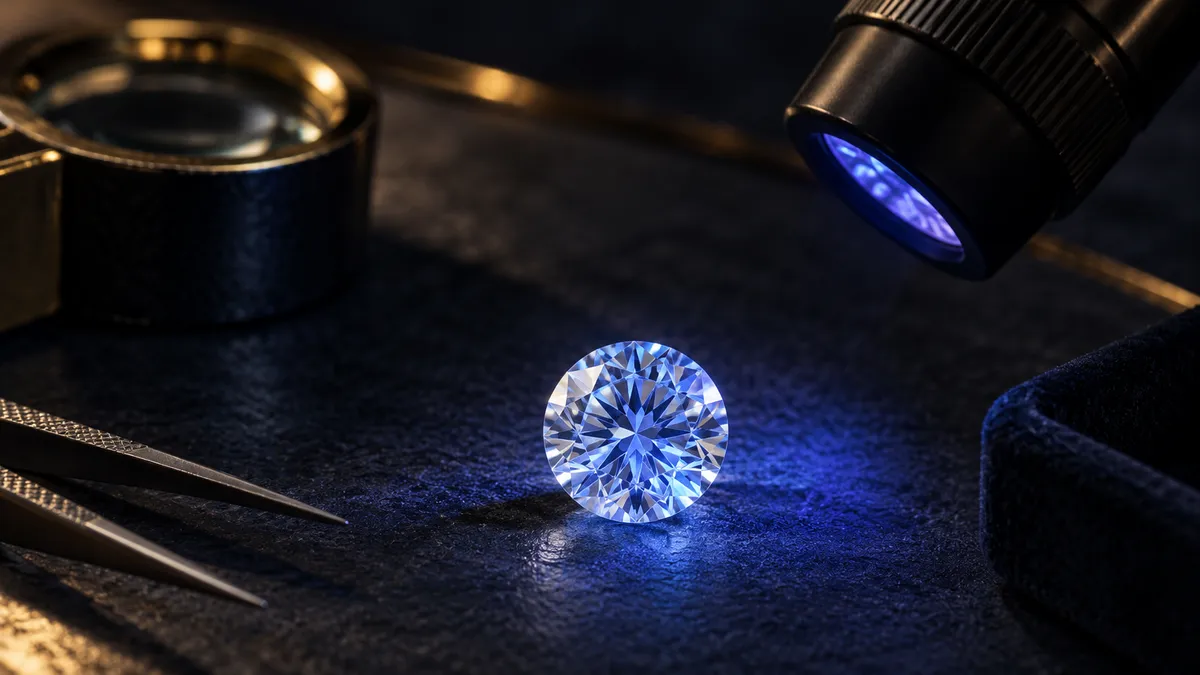
Fluorescence is a diamond’s reaction to ultraviolet light, usually a blue glow. For most stones it has no visible effect in ordinary light; in lower colours it can even make them look whiter. Only very rarely, with strong fluorescence, can a stone look slightly milky. The trade nevertheless discounts medium and strong fluorescence, especially in high colours.
Put a diamond under a UV lamp and it may glow blue. The phenomenon is called fluorescence, and it appears on almost every laboratory report. Some sellers treat it as a flaw, others as a selling point. In reality it is a characteristic of the stone, to be judged case by case.
What fluorescence is
Some diamonds contain trace elements or lattice defects that absorb ultraviolet light and re-emit it as visible light. The usual colour is blue; yellow, green or orange occur more rarely. The effect is obvious under the gemmologist’s UV lamp. In daylight, which also contains a little ultraviolet, it is usually imperceptible.
How it appears on a report
HRD Antwerp grades fluorescence on four steps: nil, slight, medium, strong, under long-wave UV light; blue is the usual colour. GIA uses a similar scale: None, Faint, Medium, Strong, Very Strong. The names differ slightly, but the idea is the same: how intensely the stone reacts.
How common it is, and when it shows
According to GIA data, between a quarter and a third of diamonds show fluorescence, and only a small share of those have medium or higher intensity. Cases where a stone looks hazy or “oily” because of fluorescence are very rare, under 0.2% of the fluorescent stones tested.
A 1997 GIA study showed near-identical stones, with and without fluorescence, to graders, trade professionals and ordinary observers. Ordinary observers saw no systematic effect. Strongly fluorescent stones were even perceived, viewed face-up, as having slightly better colour. The explanation: the blue slightly offsets the yellowish tint of stones in the I–M range.
Why the price still drops
The Rapaport price list, the trade’s benchmark, assumes stones without medium or strong fluorescence. Fluorescence is handled as a percentage discount: from almost nothing for faint fluorescence up to roughly a quarter of the price for very strong fluorescence in high colours, D–F. In lower colours the discount is small or absent.
The discount also has a historical explanation. “Blue white” stones were once sought after; then a few strongly fluorescent, hazy stones (“overblue”) brought suspicion on the whole category. The reputation stuck, even though most fluorescent stones look impeccable.
How to choose
- Colours D–G: if you will resell the stone, strong fluorescence lowers the price. If you are buying it for yourself and it looks clear, the discount can be an advantage.
- Colours H–M: medium or strong fluorescence can make the stone look whiter. It is worth considering.
- Look at the stone in daylight and under ordinary indoor light. If you see no haze, fluorescence is not an appearance problem.
- Do not buy a “strong” stone from a photograph alone: transparency must be judged on the real specimen.
Fluorescence also helps with identification: differences in UV reaction are among the tests that separate natural diamonds from laboratory-grown ones. For an indicative estimate of value, use our valuation calculator; fluorescence is then assessed during the examination.
Sources and further reading
GIA, Gems & Gemology — The effect of blue fluorescence on the appearance of diamonds (1997)
Rapaport Magazine — On the perception of fluorescent diamonds (2020)
Rapaport Magazine — Five facts about diamond fluorescence (2026)
HRD Antwerp — Frequently asked questions (fluorescence scale)
Research: 12 October 2026. An informative editorial guide; identifying a gemstone requires examination of the individual specimen.