HRD vs GIA scale: what LC, VVS and P1 mean on a report
The HRD and GIA scales share the same middle grades (VVS1–SI2) but name the extremes differently: LC (Loupe Clean) effectively covers FL and IF, while P1–P3 correspond in position to I1–I3. For colour, both use the letters D–Z; HRD adds names such as Exceptional White or Rare White. The equivalence is practical, not an official conversion table.
On a laboratory report, a diamond’s clarity and colour appear as abbreviations: VS1, SI2, G, H. Most buyers know the GIA scale, but an HRD Antwerp report uses a few names of its own: LC instead of FL or IF, P1–P3 instead of I1–I3, and names such as “Rare White” for colour. The differences are smaller than they seem, as long as you know where the match is only approximate.
Clarity: ten grades, assessed with a 10× loupe
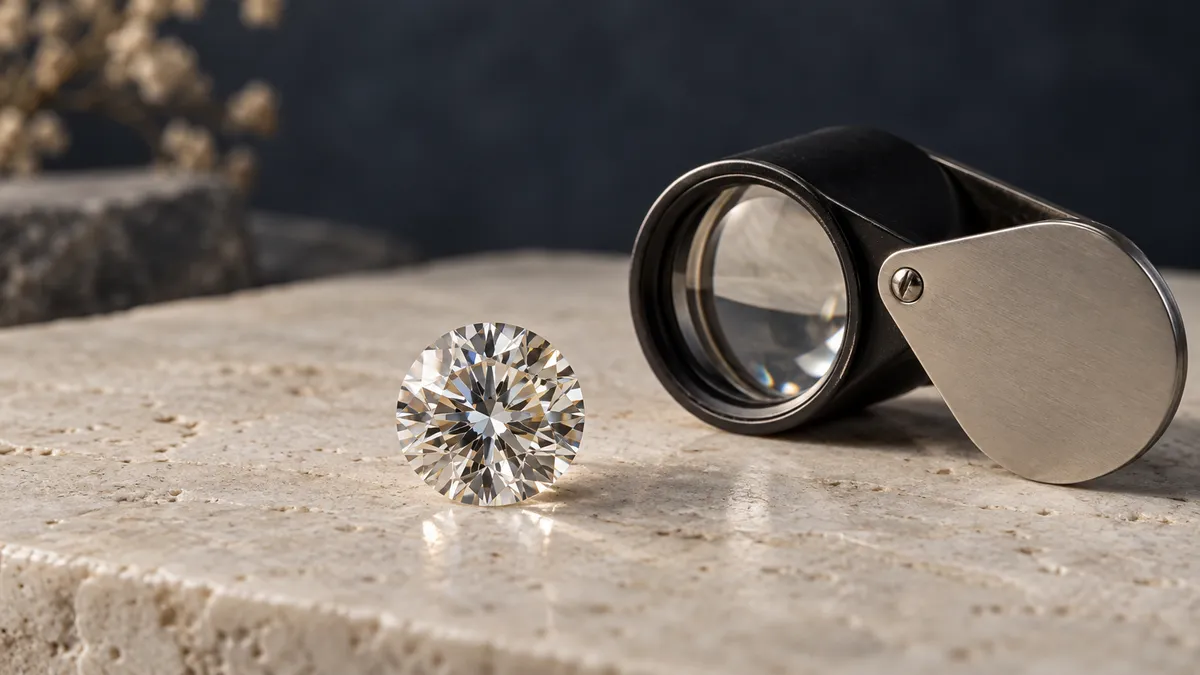
HRD Antwerp grades clarity on ten steps: LC, VVS1, VVS2, VS1, VS2, SI1, SI2, P1, P2, P3. The grade is set with a 10× triplet loupe, according to the size, number and position of the internal characteristics. The grades group as follows:
- LC (Loupe Clean): no internal characteristics visible under a 10× loupe; the best and rarest grade.
- VVS1, VVS2: very, very small inclusions, hard to find even for an experienced grader.
- VS1, VS2: very small inclusions, visible under the loupe, usually invisible to the naked eye.
- SI1, SI2: small inclusions, easy to see under the loupe; in some stones, especially SI2, visible without one.
- P1, P2, P3 (“piqué”): inclusions visible to the naked eye, which can affect brilliance and, at P3, the stone’s durability.
Equivalence with the GIA scale
HRD does not publish an official conversion table, but in practice the scales are read like this:
- LC ≈ FL and IF. GIA separates FL (no inclusions and no surface blemishes) from IF (no inclusions, with minor finishing marks on the surface). HRD combines them into a single grade.
- VVS1 to SI2 have the same names in both systems.
- P1, P2, P3 occupy the place of GIA’s I1, I2, I3 (“included”) on the scale.
Note: the same stone examined by two laboratories may receive different neighbouring grades, for example VS1 at one and VS2 at the other. That is not necessarily an error. Grading compares the stone with a standard and involves the grader’s judgement. So compare reports from the same laboratory, or have the stone examined.
Colour: letters from D to Z, and names
Both laboratories determine colour by comparison with master stones, on a scale from D, completely colourless, to Z, with a visible tint. HRD Antwerp also uses names: Exceptional White+, Exceptional White, Rare White+, Rare White, White, Slightly Tinted White+, Slightly Tinted White, Tinted White+, Tinted White and Tinted Colour.
HRD explicitly links D to Exceptional White+, E to Exceptional White and F to Rare White+. On HRD reports seen in practice, G appears as Rare White and H as White, with the letters I–L as variants of “Slightly Tinted” and “Tinted White”. The letter remains the most reliable reference: the name describes it, it does not replace it.
Diamonds with an intense colour (yellow, pink, blue, green) are not graded on the D–Z scale but as “fancy” diamonds, using a different assessment method.
What it means for you when buying
- Compare colour letters and clarity grades, not the trade names used in advertising.
- An LC and a VVS2 diamond usually look identical to the naked eye; the price difference pays for rarity, not for a visible effect.
- At SI2 and P1, ask to see the stone, not just the report: the position of the inclusion matters more than the grade.
- Check the report on the issuing laboratory’s website and make sure the data match the stone in front of you.
For the bigger picture, read about the 4Cs of a diamond. If you already have a report and are unsure what it means, we can read it together during a diamond examination.
Sources and further reading
HRD Antwerp — The 4Cs (clarity, colour, cut, carat)
HRD Antwerp — Frequently asked questions
Research: 12 October 2026. An informative editorial guide; identifying a gemstone requires examination of the individual specimen.