What 2025 FTIR research adds to detecting heat in ruby and sapphire
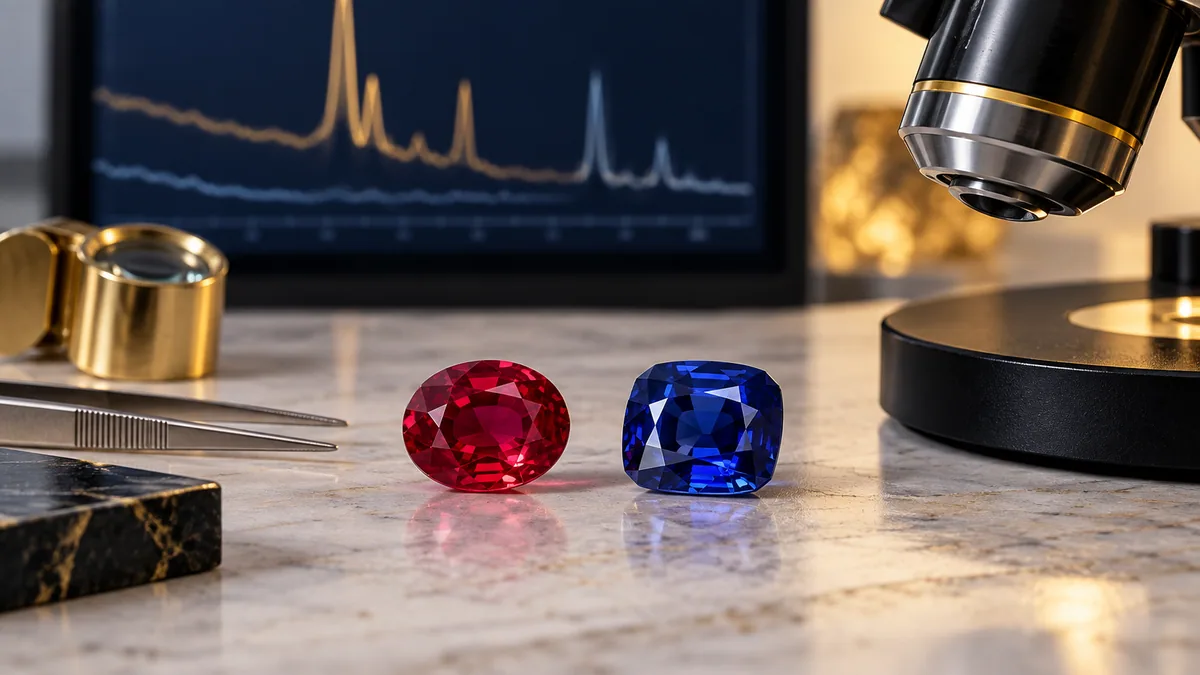
Some treatments leave no easily observed microscopic signs. Gemmology also uses instrumental measurements, with research continually refining interpretation.
What the paper studied
In the spring 2025 issue of Gems & Gemology, Wasura Soonthorntantikul and Aaron C. Palke analysed the infrared signal series around 3309 cm⁻¹ in ruby and sapphire. FTIR means Fourier-transform infrared spectroscopy, examining a material's radiation absorption. The authors studied signal-position variations related to composition.
Interpretation has limits
The paper distinguishes a signal series from a single nearby peak. In certain corundum types, data can help identify heating. Geological context and other characteristics matter; the series can also occur in sapphires associated with natural processes. It is not a universal “peak present, therefore treated” test.
What buyers can use
You need not interpret spectra yourself. You need a document stating the examination's conclusion and limits. If an offer claims no heating, ask which laboratory examined the stone and what its report says exactly.
A graph screenshot without specimen identification and methodology is not equivalent to a report for your stone. Request the connection between result and item, rather than merely an impression of advanced technology.
Why follow research?
Progress offers more precise questions and better explained results. It does not imply every earlier report is wrong. Re-examination depends on the item and unresolved question.
Continue with ruby treatments and sapphire treatments.
Sources and further reading
Research: 16 September 2026. An informative editorial guide; identifying a gemstone requires examination of the individual specimen.