Sapphire, tanzanite or aquamarine: three ways to choose blue
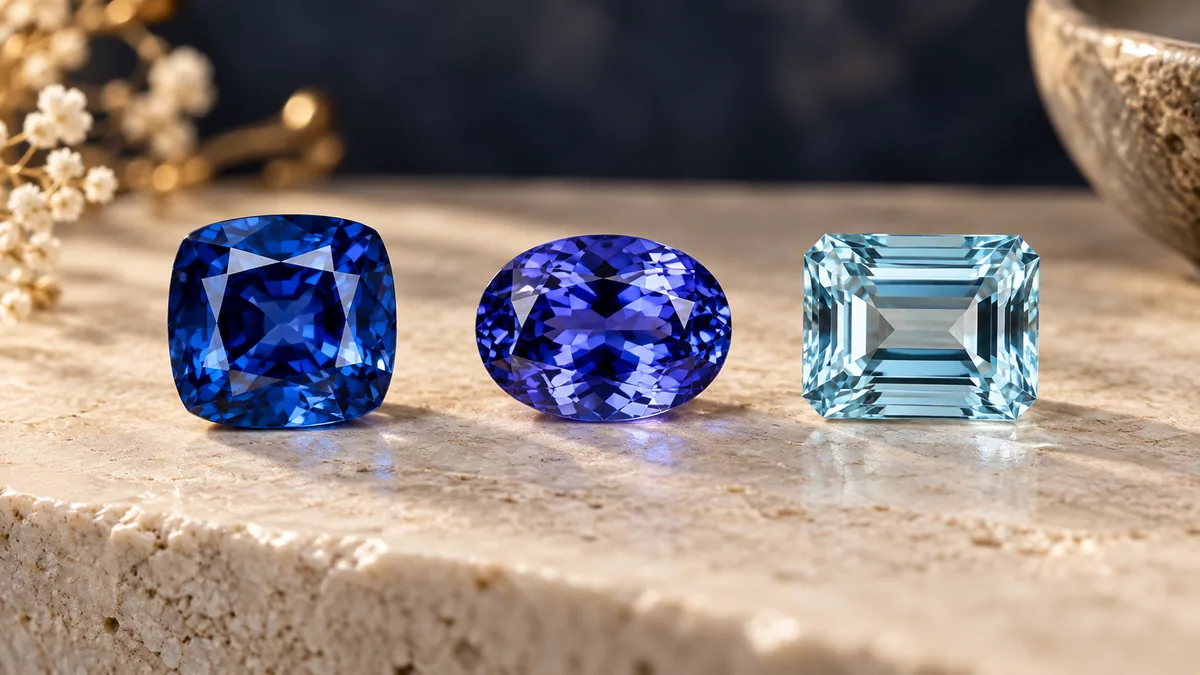
Intense blue, blue-violet or an airy shade can lead to different choices. Rather than asking which stone is best, establish what you want from the jewellery.
Identity at a glance
- Sapphire is corundum and occurs in many colours, including blue.
- Tanzanite is blue-to-violet zoisite, with appearance affected by orientation.
- Aquamarine is blue-to-greenish-blue beryl.
“Blue stone” gives insufficient information for cleaning, valuation or replacement in a setting.
Start with wearing habits
For a ring, discuss durability and setting protection. Tanzanite has cleavage and requires care around knocks. Sapphire care advice cannot automatically apply to tanzanite. Treatments and condition can change recommendations for each item.
A pendant may prioritise hue and proportions. Try the complete jewellery dimensions rather than only a photographed stone outline.
Compare under the same light
Use a neutral background. Observe whether you prefer lighter or saturated colour and how appearance changes in motion. A violet tanzanite should not be digitally corrected to resemble sapphire.
Record length and width. Equal weights in different minerals do not guarantee equal visible size. For earrings, inspect matching as well as individual quality.
Finish with documents
Ask for identity, treatments and available origin information. Read our dedicated guides to sapphire, tanzanite and aquamarine. Choose the specimen for its use rather than a universal gemstone hierarchy.
Sources and further reading
GIA — gemmological reference · GIA — gemmological reference · GIA — gemmological reference · GIA — gemmological reference
Research: 16 September 2026. An informative editorial guide; identifying a gemstone requires examination of the individual specimen.