How to read an HRD Antwerp grading report, line by line
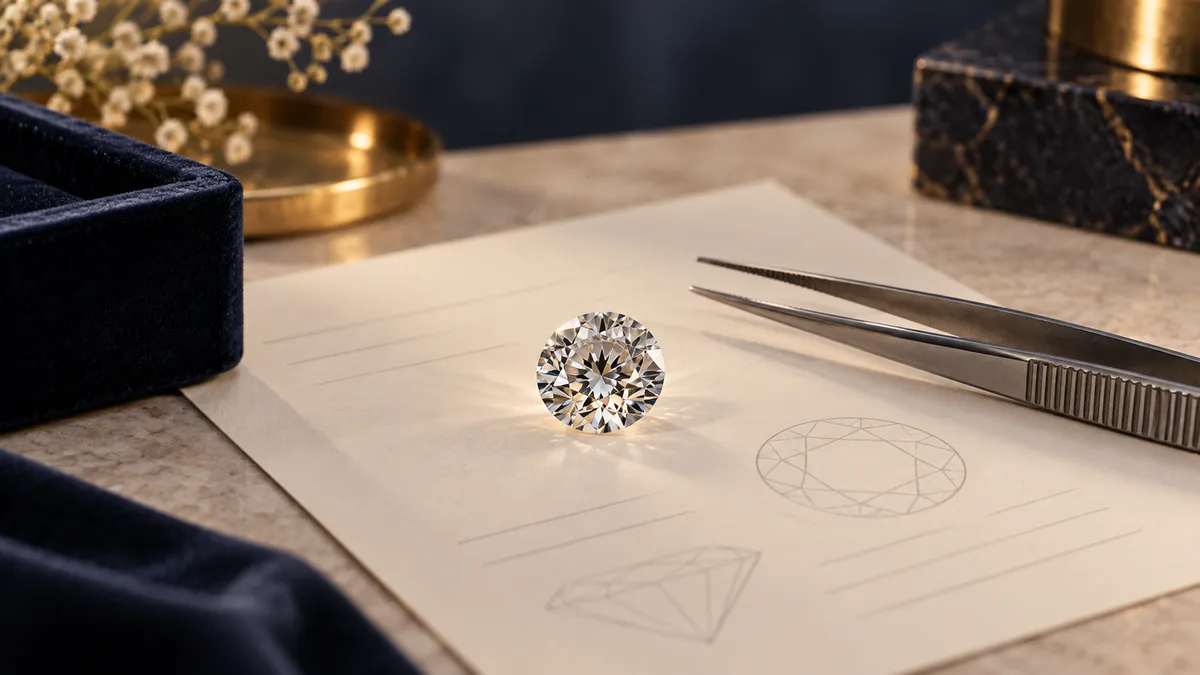
An HRD Antwerp report for a natural diamond records weight, colour, clarity, cut (proportions, polish, symmetry), fluorescence, measurements in millimetres and a diagram of the inclusions. There are separate reports for laboratory-grown diamonds, for jewellery and for stones under 1 ct. The report describes the stone, but it does not set a price.
An HRD Antwerp report describes a diamond in measurable terms. If you know what each line means, you can compare two stones and check whether the stone in front of you is the one in the document.
First: which type of report you have
HRD Antwerp issues several types of document, and the title tells you what was examined:
- Natural Diamond Grading Report: the full report for an unmounted natural diamond.
- Natural Diamond Identification Report: the shortened version for stones under 1 ct.
- Natural Diamond Colour Grading Report: for coloured diamonds, with the origin and characteristics of the colour.
- Laboratory Grown Diamond Grading Report: for laboratory-grown diamonds, identified as such right on the cover.
- Jewellery Report (including the compact version): for jewellery, with the metal, its weight, the number of diamonds and approximate 4C values.
The nature of the stone (natural or laboratory-grown) is the first thing to check. The other lines only make sense after that.
The lines of the report
- Shape and cut: for example round brilliant, princess, oval.
- Weight: in carats, to five decimal places. One carat is 0.2 g, or 100 points. The exact weight helps identify the stone more than any other line.
- Colour: the letter D–Z, with the HRD name (for example Rare White). See our guide to the HRD and GIA scales.
- Clarity: from LC to P3, assessed with a 10× loupe.
- Cut: three separate grades, for proportions, polish and symmetry (Excellent, Very Good, Good, Fair). Proportions are graded for round brilliants; fancy shapes usually receive only polish and symmetry.
- Fluorescence: nil, slight, medium or strong, under long-wave UV. Details in our guide to fluorescence.
- Measurements: minimum and maximum diameter and height, in millimetres, plus total depth and table percentages.
- Diagram: a drawing of the stone with the positions of the inclusions marked by symbols.
How these values are reached
HRD describes a fixed sequence: the stone is weighed, then screened (natural, laboratory-grown or treated; unclear cases go to the research department), measured, tested for fluorescence and only then graded for colour, clarity and cut. A double coding system hides the owner’s identity from the graders, for objectivity.
What to check before relying on a report
- Physical match: weight, measurements and diagram must fit the stone. A genuine report can accompany a different stone.
- The laser inscription, if present on the girdle, must match the report number.
- The document’s authenticity: its security features and the laboratory’s online archive. We have written separately about the security features of a certificate.
- Issue date: a stone repolished or damaged after issue no longer matches the report.
What the report does not tell you
A grading report describes the stone. It does not set a price, does not assess the setting except in jewellery reports, and does not guarantee resale value. A market value or an insurance value requires a separate appraisal, for example an insurance valuation.
Do you have an HRD report and want to know whether the stone matches it? The check is quick, by appointment.
Sources and further reading
HRD Antwerp — Diamond grading reports
HRD Antwerp — Services and security features
Research: 12 October 2026. An informative editorial guide; identifying a gemstone requires examination of the individual specimen.