Ruby, spinel or garnet: choosing a red gemstone
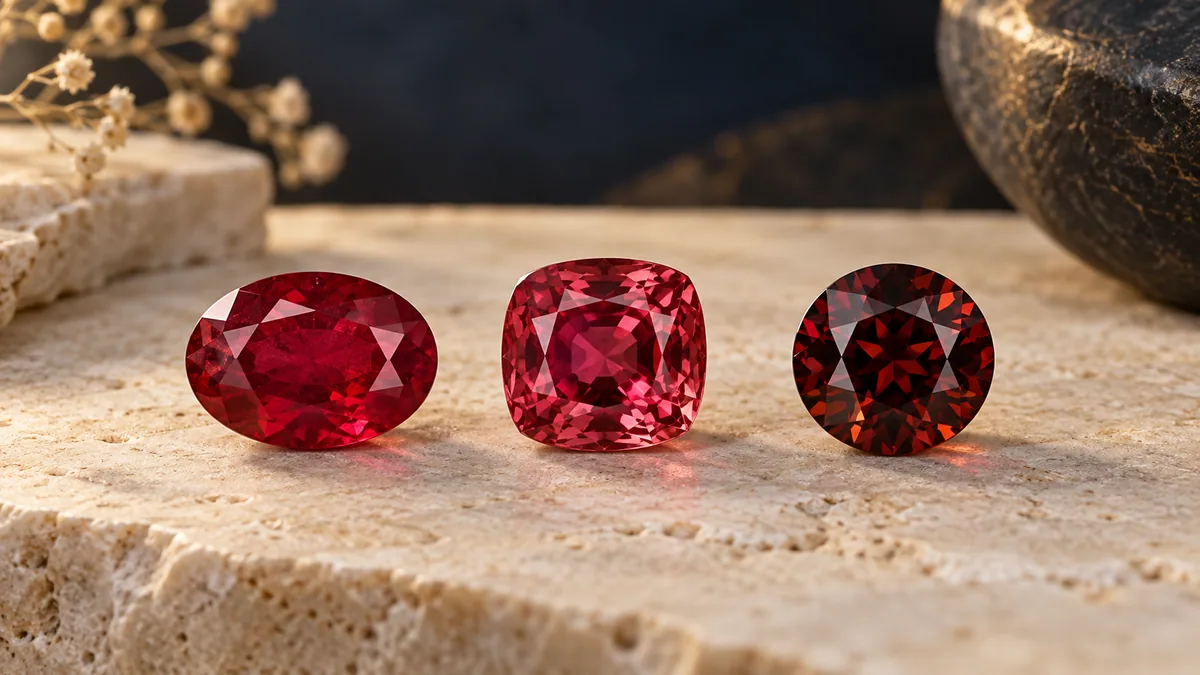
Red jewellery offers more options than ruby alone. Start with your desired appearance, then identify each stone rather than treating its name as an automatic verdict.
Three different identities
- Ruby: red corundum.
- Spinel: a distinct mineral that can be red.
- Garnet: a mineral group including red and purplish-red varieties.
Shared colour does not imply shared properties. Photographs cannot reliably separate every material; examination is required.
Compare in four steps
1. Define use. Is it a frequently worn ring, pendant or collection specimen? Record dimensions and style before starting with the gemstone name.
2. Compare appearance. View options under the same light. Observe hue, darkness and appearance against skin. Do not compare a professional macro image with a phone capture.
3. Read documents. Separate natural from laboratory material, treatments from geographic origin, and stone weight from jewellery weight. Mark missing information as unknown.
4. Compare complete offers. Include setting, condition, services and transaction terms. No universal price ratio applies between every ruby, spinel and garnet.
A decision example
For earrings, a well-matched garnet pair may appeal more than mismatched rubies. A mineral collection may use different criteria. Purpose explains the choice rather than proving general superiority.
Explore ruby, spinel and garnets separately before selecting a specimen.
Sources and further reading
GIA — gemmological reference · GIA — gemmological reference · GIA — gemmological reference
Research: 16 September 2026. An informative editorial guide; identifying a gemstone requires examination of the individual specimen.