Solid opal, doublet or triplet: what are you buying?
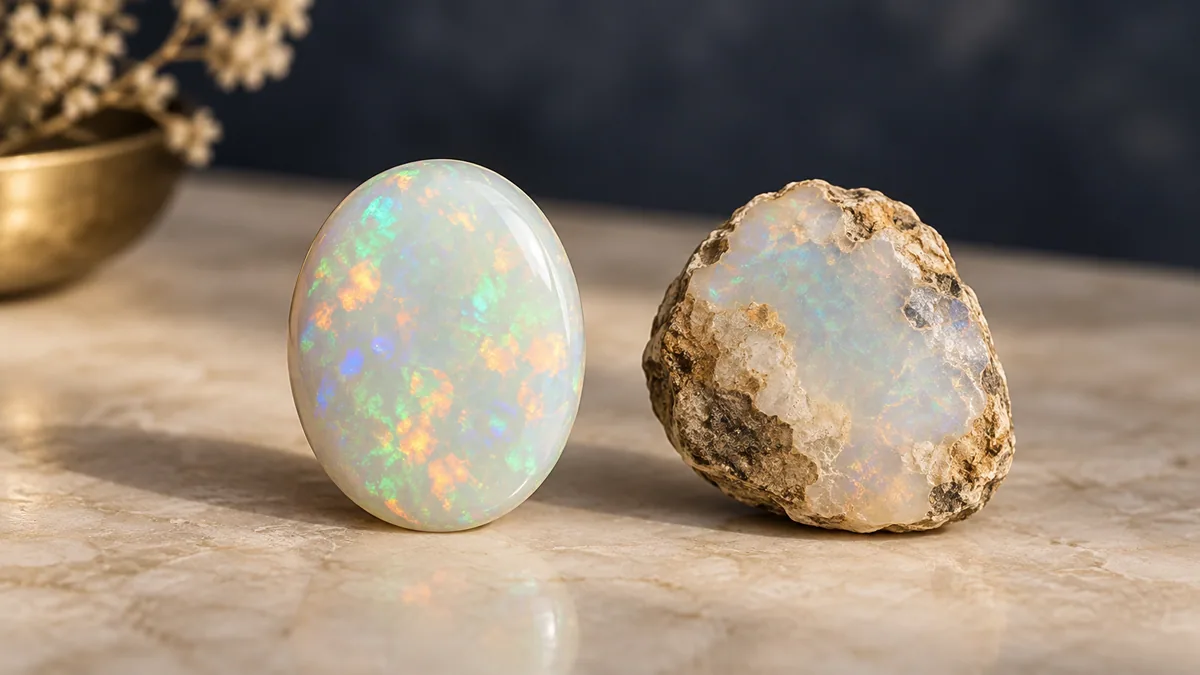
Play-of-colour may immediately attract attention, but construction needs separate clarification. An item can contain natural opal while consisting of several glued components.
How constructions differ
Solid opal is a single piece of material. A doublet usually combines an opal layer with a backing. A triplet adds a transparent top layer. These assemblies can be attractive but must be disclosed and compared with similarly constructed products. Synthetic opal is a separate identity question.
Why side views matter
Request profile and reverse photographs. A closed setting can hide useful examination areas, so an invisible join in a front photograph does not prove the stone is solid. Identification concerns the examined object, not just an advertisement.
When buying online, ask explicitly whether it is solid, a doublet or a triplet. A statement about natural colours does not clarify construction. Ask for the answer in the transaction documents.
Comparing practical choices
Observe play-of-colour in motion and ordinary light. Record visible dimensions, setting type and care instructions. Pass these details on with a gift: a beautiful box does not explain maintenance.
Do not use soaking as an identification test for layered jewellery. Read about hydrophane opal for porous materials. Gemmological identification can clarify an incomplete description.
Sources and further reading
Research: 16 September 2026. An informative editorial guide; identifying a gemstone requires examination of the individual specimen.